.svg)

Renting out a property in Portugal has never been more regulated — or more financially risky if you get it wrong. The lease agreement is the legal foundation of the entire landlord-tenant relationship. A poorly drafted contract can leave you unable to evict a non-paying tenant for months, cost you thousands of euros in legal fees, and expose you to tax penalties.
This guide explains exactly how to draft a legally compliant residential lease agreement in Portugal in 2026, following the NRAU (Novo Regime do Arrendamento Urbano) and the changes introduced by the Mais Habitação law (Lei n.º 56/2023).
What Does the Law Say? (NRAU & Mais Habitação)

All residential rental agreements in Portugal are governed by the NRAU, approved by Lei n.º 6/2006 and significantly amended by Lei n.º 56/2023 (known as Mais Habitação). Understanding these two frameworks is the starting point for any lease.
Key principles under the NRAU:
- Leases must be in writing — oral agreements have no legal effect for residential tenancies.
- The minimum lease duration is 1 year for standard residential leases.
- Leases automatically renew at the end of the term unless proper notice is given.
- Rent increases are capped by the annual coefficient published by the INE (National Statistics Institute).
- Landlords must register the lease with the Tax Authority (AT) within 30 days of signing.
What Mais Habitação changed in 2023:
- Mandatory registration strengthened: since August 2025, tenants can self-register if the landlord fails to do so.
- Rent caps introduced in ‘housing pressure zones’ (zonas de pressão habitacional).
- Stronger tenant protections for vulnerable households.
- Restrictions on converting residential units to short-term tourist rental (Alojamento Local).
Mandatory Clauses
A valid residential lease in Portugal must include the following elements — their absence can make the contract void or unenforceable:
- Full identification of both parties (landlord and tenant): name, tax number (NIF), address.
- Full description of the property: address, type, area, tax registry reference (artigo matricial).
- Lease term: start date, initial duration, and auto-renewal conditions.
- Monthly rent amount and due date.
- Payment method (bank transfer, direct debit).
- Security deposit amount (usually 1–2 months’ rent, maximum 2 under NRAU).
- Permitted use: the property must be stated as for ‘exclusive private residential use’.
- Rules on works and maintenance (following Art. 1074 of the Civil Code).
- Governing law clause: reference to the NRAU and Portuguese Civil Code.
Missing any of these elements can create disputes — or give a clever tenant the grounds to challenge the contract.
Recommended Clauses (Non-Mandatory but Strongly Advised)
Beyond the legal minimum, experienced Portuguese landlords typically add these clauses to protect their interests:
- SEPA Direct Debit authorisation: automates rent collection and eliminates non-payment excuses.
- Rental income insurance (GLI) declaration: confirms whether insurance is in place — and creates a record of it.
- Sub-letting prohibition: explicitly bans sub-letting without written consent.
- Pet policy: whether pets are permitted and any related conditions.
- Property inspection clause: agreeing to a move-in and move-out inspection report.
- Utilities: clarify which services are in the tenant’s name vs. the landlord’s.
- Notice delivery method: specify that formal notices must be sent by registered mail (correio registado).
How to Register the Lease with Finanças
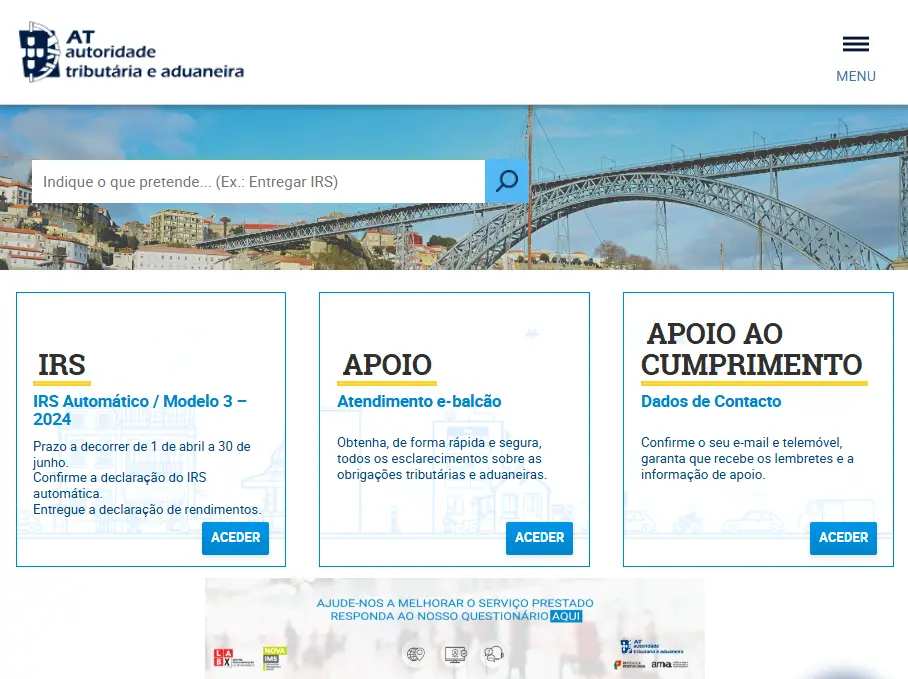
Registration with the Autoridade Tributária (AT) via the Portal das Finanças is mandatory within 30 days of signing. Here is how to do it:
- Log in to the Portal das Finanças (portaldasfinancas.gov.pt) with your NIF and password.
- Go to: ‘Imóveis’ > ‘Arrendamento’ > ‘Comunicar Contrato de Arrendamento‘.
- Enter the property’s artigo matricial, tenant details, rent amount, and start date.
- Upload a signed copy of the lease.
- Keep the confirmation reference number.
Since August 2025, if the landlord fails to register within 30 days, the tenant can initiate self-registration (auto-registo). This does not penalise the landlord directly but creates a record that can be used in disputes. Register on time.
Most Common Mistakes to Avoid
- Using an outdated template: lease templates from before 2023 do not reflect Mais Habitação changes.
- Not registering with Finanças: exposes you to fines and invalidates tax deductions.
- Vague property description: always include the artigo matricial.
- No security deposit clause: you lose your legal right to retain it on damages.
- Ignoring the rent cap: increases above the official coefficient are legally void.
- Not keeping a signed copy: always retain one original, signed by both parties.